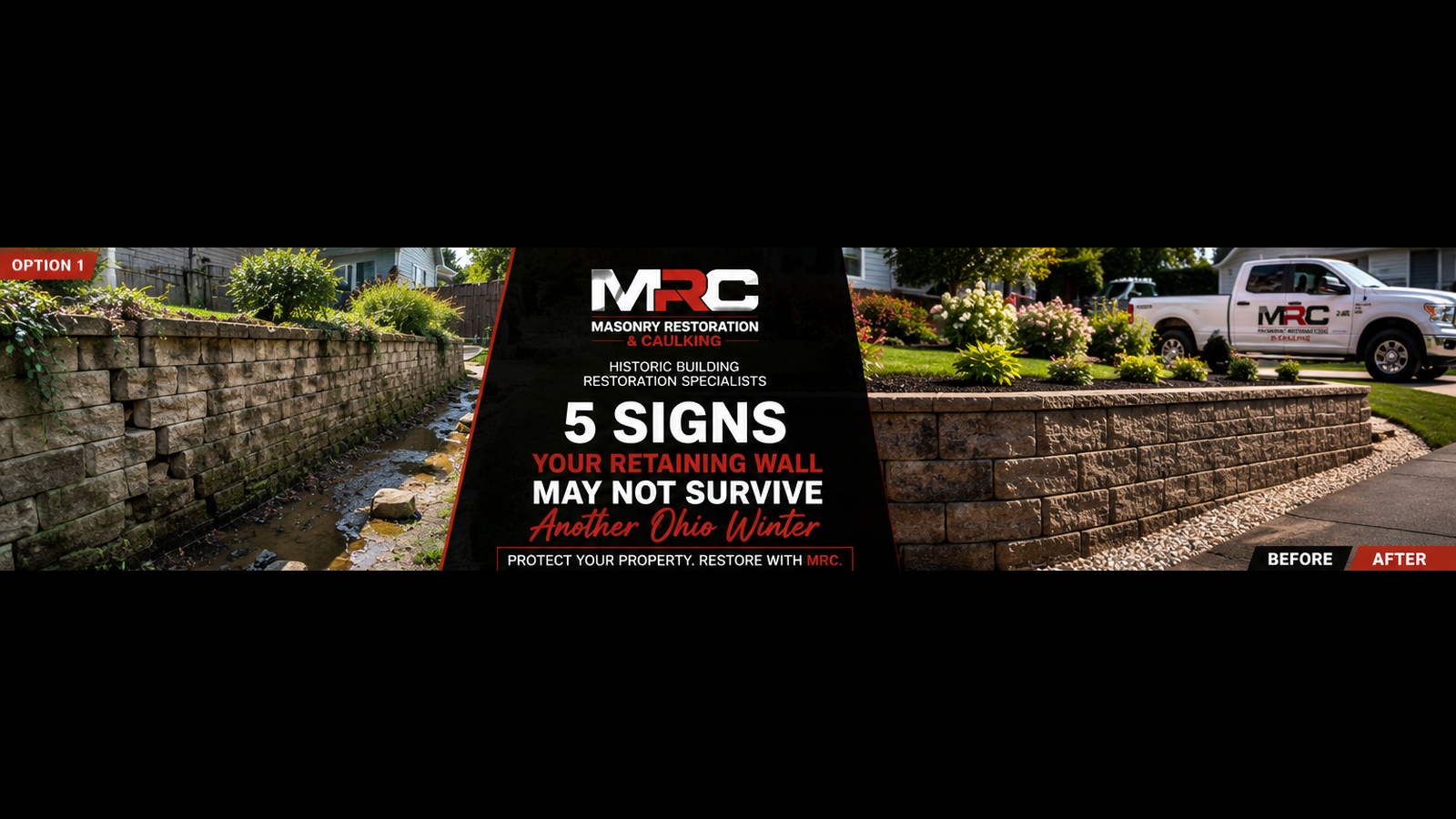
Five Signs Your Retaining Wall May Not Survive Another Ohio Winter
By the MRC Restoration Team
Retaining walls do more than improve the appearance of your property. They hold back soil, control drainage, protect foundations, and help prevent erosion. When a retaining wall begins to fail, the damage often starts slowly. Small cracks, leaning sections, and drainage problems may not seem serious today, but another Ohio or Michigan winter can quickly turn those minor issues into a costly restoration project.
Summer is one of the best times to inspect retaining walls. The ground is easier to evaluate, drainage problems are more visible, and repairs can usually be completed before freezing temperatures return.
If your retaining wall shows any of the warning signs below, now is the time to schedule an inspection.
Why Retaining Walls Fail
Retaining walls are constantly under pressure.
Every rainstorm adds moisture to the soil behind the wall. As the soil becomes heavier, it pushes outward. During winter, that moisture freezes and expands. Each freeze-and-thaw cycle increases pressure against the wall.
Over time, even a well-built retaining wall can begin to move if water is not draining properly.
Many failures are not caused by poor construction. They result from years of weather, soil movement, and drainage problems that slowly weaken the structure.
Warning Sign #1 – The Wall Is Beginning to Lean
A retaining wall should remain straight.
If you notice the top of the wall leaning forward or sections beginning to bow outward, the wall is telling you something is wrong.
The most common causes include:
- Excess soil pressure
- Poor drainage
- Freeze-and-thaw movement
- Weak or deteriorated mortar joints
A leaning wall rarely corrects itself. In most cases, the movement will continue until repairs are made.
Warning Sign #2 – Cracks Are Getting Larger
Small cracks may not seem like a major concern, but they often allow water to enter the wall.
Watch for:
- Horizontal cracks
- Stair-step cracks
- Cracks between blocks
- Separated mortar joints
These openings allow water to penetrate the structure. Once freezing temperatures arrive, expanding ice can make those cracks significantly larger.
Warning Sign #3 – Water Has Nowhere to Go
Proper drainage is one of the most important parts of any retaining wall.
If water cannot escape, pressure builds behind the wall every time it rains.
Look for:
- Standing water
- Wet soil that remains saturated
- Erosion near the base
- Water flowing through mortar joints
Drainage problems are often the hidden cause of wall failure.
Warning Sign #4 – Mortar or Blocks Are Deteriorating
Retaining walls built from brick or concrete block depend on strong mortar joints.
As mortar ages, it can begin to crack, crumble, or wash away.
You may also notice:
- Loose blocks
- Missing mortar
- Surface deterioration
- Individual sections moving independently
Addressing these issues early is usually much less expensive than rebuilding an entire wall.
Warning Sign #5 – Landscaping Is Changing
Sometimes the first sign of retaining wall movement isn’t the wall itself.
Watch your landscaping.
If you notice:
- Soil settling
- Uneven flower beds
- Sidewalk movement
- New low spots
- Mulch washing away
your retaining wall may already be shifting below the surface.
Why Summer Is the Best Time for Retaining Wall Restoration
Warm weather provides ideal conditions for restoration work.
Excavation is easier.
Drainage systems can be installed more efficiently.
Mortar cures properly.
Landscaping has time to recover before winter.
Completing repairs during the summer also gives your retaining wall the best chance of handling another season of snow, freezing temperatures, and heavy spring rains.
How Masonry Restoration and Caulking Restores Retaining Walls
Every project begins with a complete inspection.
Our team identifies movement, drainage problems, deteriorated mortar, damaged brick or block, and signs of structural failure.
Depending on the condition of the wall, restoration may include:
- Controlled excavation
- Drainage improvements
- Brick or block replacement
- Tuckpointing
- Wall stabilization
- Concrete repair
- Final grading and backfill
Rather than simply repairing visible damage, we work to correct the conditions that caused the problem in the first place.
🔨 MRC Mason’s Tip
Stand at one end of your retaining wall and look straight down its length.
If the wall bows outward, leans, or appears uneven, don’t wait until spring to have it inspected. Small corrections today are often far less expensive than rebuilding a collapsed wall after another winter.
Protect Your Property Before Winter Returns
A retaining wall protects much more than your landscaping. It helps support your property, control water, and prevent erosion.
Summer is the ideal time to inspect your retaining wall and make repairs before freezing weather creates additional damage.
Whether your property needs drainage improvements, tuckpointing, wall stabilization, or complete retaining wall restoration, the experienced team at Masonry Restoration and Caulking can help.
We proudly serve homeowners, commercial property owners, and municipalities throughout Toledo, Perrysburg, Sylvania, Maumee, Holland, Monclova, Temperance, Lambertville, and the surrounding communities of northwest Ohio and southeast Michigan.
If your retaining wall is showing signs of movement or deterioration, contact Masonry Restoration and Caulking today to schedule a professional inspection and restore your wall before another winter takes its toll.
Call 567-999-9672 or schedule caulking service with Masonry Restoration and Caulking.
15 Comments
https://addlinks.pro/b4jJi
I AM BACK AGAIN
The content is really great
cuAbdtnksGgGXLfC
https://addlinks.pro/rLMza
JYcMdzawxGxkCfFRHvKVBg
https://addlinks.pro/AUhcf
MglVYSUEcUJzHFlZxjKdf
https://addlinks.pro/6Su9V
https://addlinks.pro/ydzbB
That was amazing
DbKQuzjcABfXKsCWkotQ
Здравствуйте. Хотел уточнить по поводу ваших услуг некоторые моменты. Отпишите пожалуйста мне на sergejgnasko0@gmail.com хочу это обсудить
Hi,how are you
Its Amazing
Recent Posts
Recent Comments
Recent Posts
Recent Comments
Archives
Categories
Meta